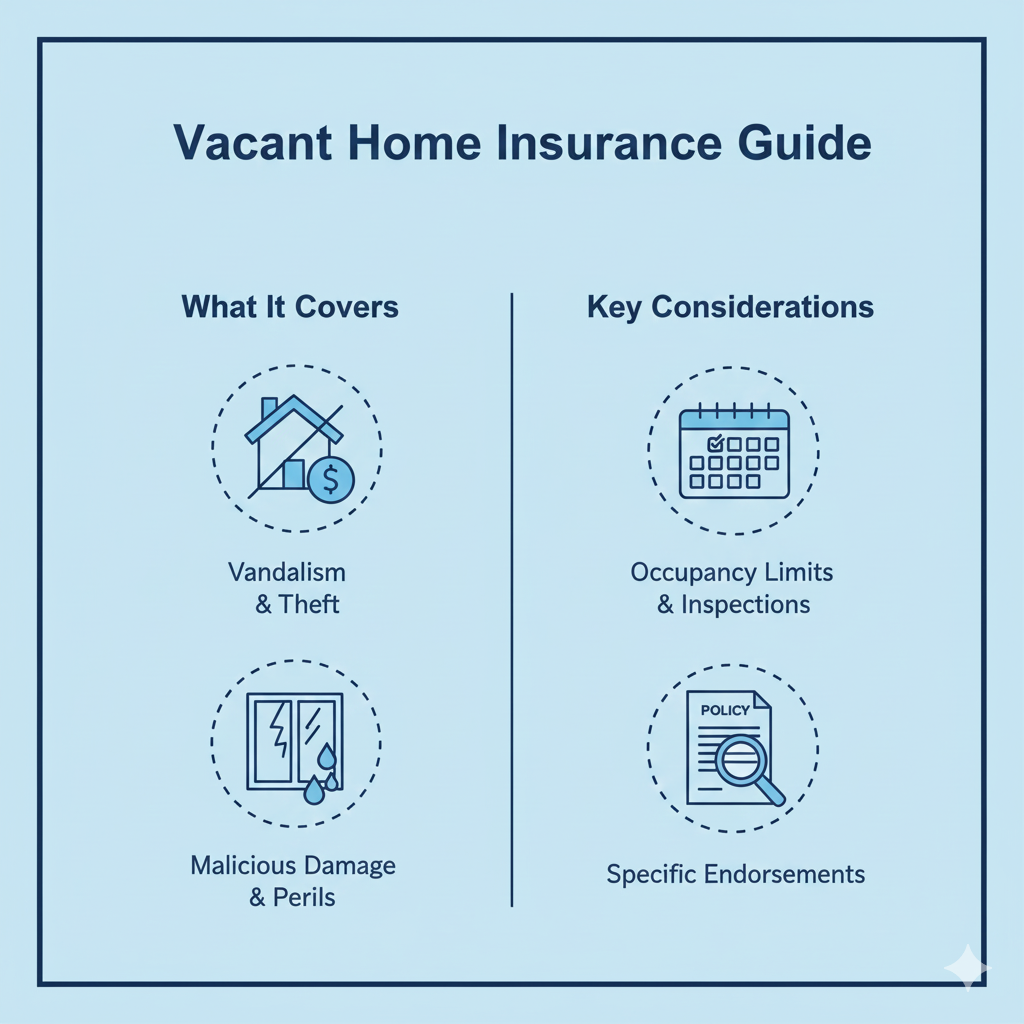
Dealing with an Empty House? Why Standard Insurance WON'T Cover You
Maybe you inherited a home and it's sitting empty while you sell it. Maybe you are renovating a flip. Maybe you are a snowbird gone for 4 months.
Regardless of the reason, if your house is empty, your standard insurance policy is likely useless right now.
The 30/60 Day Rule
Every home insurance policy has a "Vacancy Clause." It states that if a home is vacant (meaning no furniture, no people) or unoccupied (furniture, but no people) for more than 30 or 60 days, coverage is suspended.
Why? The Risk is Huge.
- Vandalism: Empty houses attract broken windows and graffiti.
- Theft: Copper pipes are stripped from walls.
- Squatters: People move in, and thanks to tenancy laws, it takes months to evict them.
- Undetected Damage: A small leak under the sink turns into a mold catastrophe because nobody is there to see it for 3 weeks.
Unoccupied vs. Vacant
Insurers distinguish between these two words:
-
Unoccupied: The house is ready to be lived in (has beds, tables, power is on),
but the owner is on vacation.
Easier to insure. -
Vacant: The house is empty. No furniture. Utilities might be off.
Very hard/expensive to insure.
Solution 1: Vacancy Permit
If the vacancy is temporary (e.g., typically 3-6 months), ask your current insurer for a "Vacancy Permit" endorsement.
This effectively "buys back" the coverage. It will cost extra, and coverage might reduce (e.g., they might cover Fire but not Vandalism), but it keeps a policy in force.
Solution 2: Vacant Home Policy
If the house will be empty for a year or more (e.g., a major renovation or a stubborn listing), you need a specialized DP-1 or DP-3 Vacant Home Policy.
These are "Named Peril" policies. They cover the basics (Fire, Wind, Lightning) but usually exclude theft, water damage, and vandalism unless you pay extra premiums.
Tips for Managing an Empty Home
- Install Smart Sensors: Water leak detectors and Wi-Fi cameras allow you to monitor the home remotely.
- Mow the Lawn: Long grass is a billboard that says "Nobody lives here."
- Set Timers: Put lights on timers to simulate activity.
- Turn off Water: If possible, shut off the main water supply and drain the pipes to prevent freezing/bursting.
HomeInsuranceQuotes360 Team
Specialty Insurance