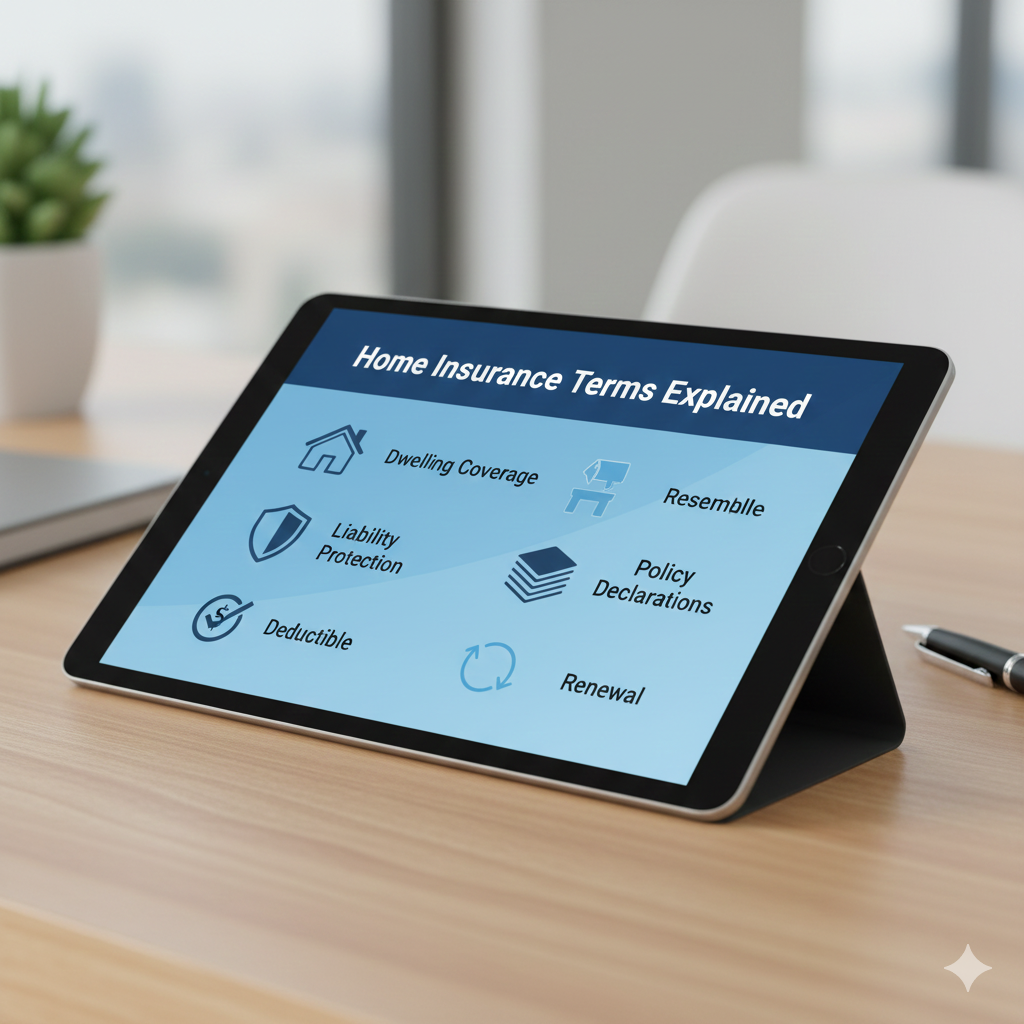
The Ultimate Home Insurance Glossary: Every Term Explained
Insurance policies are written by lawyers, for lawyers. If you feel like you are reading a foreign language when looking at your declaration page, you are not alone.
Understanding these terms can literally save you thousands of dollars. We have compiled the most comprehensive A-Z glossary of home insurance terms on the web. Bookmark this page!
A
Actual Cash Value (ACV)
The value of your property minus depreciation. For example, if you bought a laptop for $1,000 five years ago, its ACV might only be $200 today. If you have an ACV policy, the insurer will only pay you $200.
Additional Living Expenses (ALE)
Coverage that pays for extra costs if you cannot live in your home due to a covered loss. This includes hotel bills, restaurant meals, and laundry fees. Only the costs above your normal living expenses are covered.
Adjuster
A professional who investigates claims to determine how much the insurance company should pay. There are company adjusters (work for the insurer) and public adjusters (work for you).
All-Risk Policy
Also known as "Open Peril." A policy that covers any event unless it is specifically excluded in the policy documents. The HO-3 and HO-5 are examples of All-Risk policies for the dwelling.
B
Binder
A temporary agreement that provides proof of insurance coverage until the actual policy is issued. You typically get a binder when closing on a house.
Burglary vs. Robbery vs. Theft
Burglary: Forced entry into a structure. Robbery: Taking property by force or threat of force from a person. Theft: The general act of stealing. Insurance typically covers all three, but the definitions matter for police reports.
C
Claim
A formal request by a policyholder to an insurance company for coverage or compensation for a covered loss or policy event.
Coinsurance Clause
A provision requiring the homeowner to insure the property for a certain percentage (usually 80%) of its replacement cost. If you underinsure, the company will penalize you on partial claims.
Coverage A (Dwelling)
Covers the house itself, including walls, roofs, floors, and attached structures like garages.
Coverage B (Other Structures)
Covers detached structures on your property, like fences, sheds, or detached garages. Usually 10% of Coverage A.
Coverage C (Personal Property)
Covers your "stuff" — furniture, clothes, electronics. Coverage applies anywhere in the world, not just inside your house.
D
Declarations Page
The first page of your policy (often called the "Dec Page"). It summarizes your coverage limits, deductible, premium, and policy dates.
Deductible
The amount you must pay out of pocket before the insurance company pays a dime. Higher deductibles lower your premium, but increase your risk.
Depreciation
The decrease in value of an item over time due to age or wear and tear. Insurers use depreciation tables to calculate Actual Cash Value.
E
Endorsement
Also known as a "Rider." An amendment to your policy that adds or changes coverage. For example, adding a "Scheduled Personal Property" endorsement for a wedding ring.
Exclusion
Something specifically not covered by your policy. Common exclusions include flood, earthquake, war, and neglect.
F
Floater
Additional coverage for expensive items (like jewelry or art) that moves with the item. It typically covers accidental loss (e.g., dropping a ring down the drain), which standard policies do not.
Flood Insurance
A separate policy required to cover flood damage. Standard homeowners policies do not cover floods.
H
Hazard
Something that increases the chance of a loss. A pile of oily rags in the garage is a hazard.
HO-3 Policy
The most common homeowners insurance form. It covers the dwelling on an "Open Peril" basis and personal property on a "Named Peril" basis.
HO-5 Policy
The gold standard. Similar to HO-3, but covers personal property on an "Open Peril" basis as well. This provides broader coverage for things like mysterious disappearance.
L
Liability Coverage
Protects you if you are sued for bodily injury or property damage to others. Coverage E on a standard policy.
Loss of Use
See "Additional Living Expenses."
N
Named Perils
A list of specific events covered by the policy. If the cause of damage isn't on the list, it isn't covered. Standard named perils include fire, wind, hail, theft, and vandalism.
P
Premium
The amount you pay for your insurance policy, usually paid monthly or annually.
R
Replacement Cost Value (RCV)
The cost to replace an item with a brand new one of similar quality, without deducting for depreciation. This is the coverage you want on your policy.
S
Scheduled Property
Specific items (like a diamond ring or violin) that are individually listed on the policy with a specific value. Scheduling avoids deductibles and covers more perils.
Subrogation
The process where your insurance company pays your claim, then pursues the party properly at fault to recover the money.
U
Umbrella Policy
A separate liability policy that provides extra coverage (usually $1 million +) that kicks in after your home or auto liability limits are exhausted.
Still Have Questions?
This glossary covers the basics, but every policy is unique. If you see a term on your policy not listed here, use our contact form to ask an expert.
Ask an ExpertHomeInsuranceQuotes360 Team
Education Team