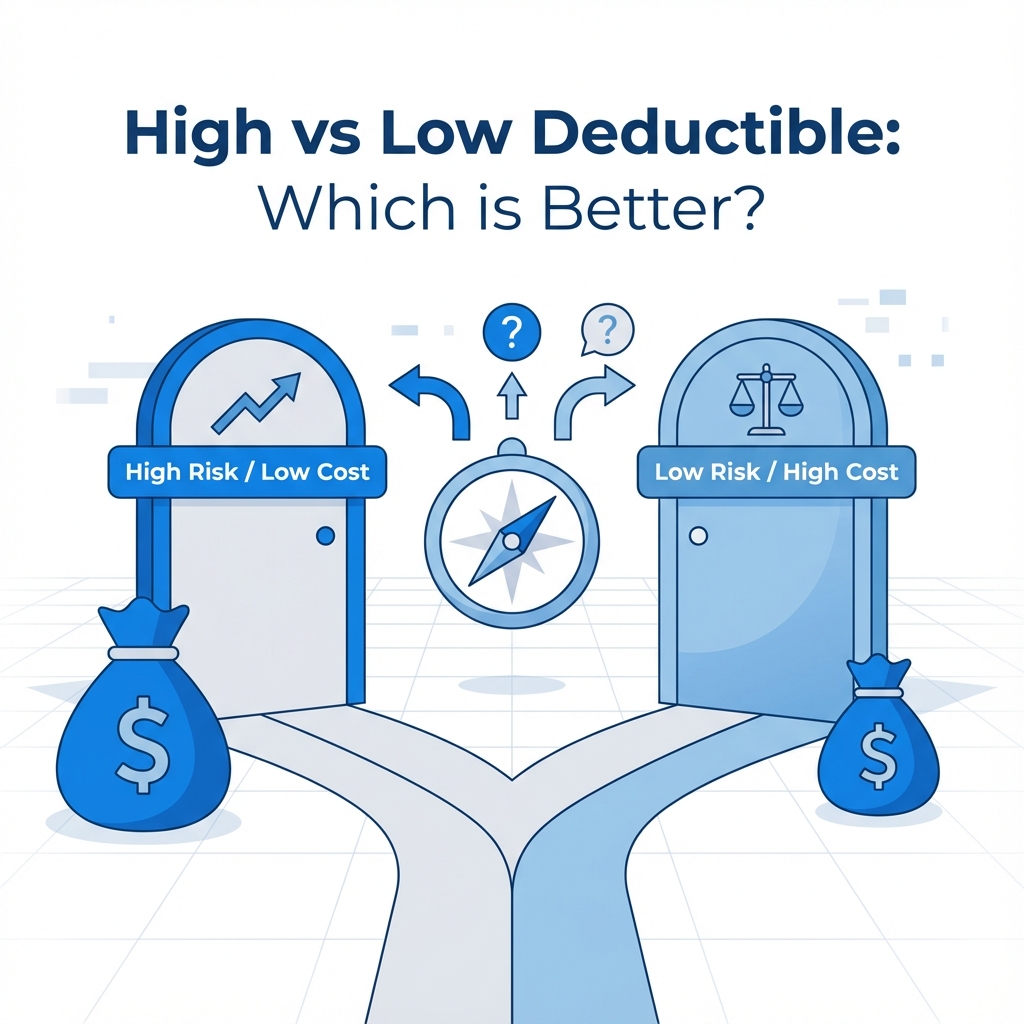
High vs. Low Deductible: Which Is Better for You?
It is the classic insurance dilemma: Do you pay more now to pay less later? Or pay less now and risk a big bill if something goes wrong?
Most agents simply ask, "What deductible do you want?" without explaining the math. Today, we are going to run the numbers to help you decide if a high deductible is actually a smart bet.
Option A: Low Deductible ($500)
Pros
If you have a claim, you only pay $500. It is easy on your emergency fund.
Cons
Your annual premium will be significantly higher. Over 5-10 years, you will likely pay thousands more to the insurance company than you would have saved on a single claim.
Option B: High Deductible ($2,500)
Pros
Massive savings. You could save 15-25% on your premium every single year.
Cons
If disaster strikes, you need to come up with $2,500 immediately.
The "Break-Even" Analysis
Let's do the math. Assume a standard policy costs $1,200/year with a $1,000 deductible.
| Deductible | Annual Premium | Savings/Year | Break-Even Time |
|---|---|---|---|
| $1,000 | $1,200 | $0 | -- |
| $2,500 | $950 | $250 | 6 Years |
In this example, choosing the higher deductible saves you $250 a year. The "risk" is an extra $1,500
out of pocket ($2,500 - $1,000).
It takes 6 years of savings ($250 × 6 = $1,500) to cover that extra risk. Since
the average homeowner files a claim only once every 9-10 years, the high deductible is
statistically the winner.
Conclusion
If you have less than $1,000 in your savings account, stick with a Low Deductible. You cannot afford the risk.
If you have a healthy emergency fund, switch to a High Deductible. Bank the premium savings every year, and you will come out ahead in the long run.
Frequently Asked Questions
What if I can't afford my deductible? expand_more
HomeInsuranceQuotes360 Team
Financial Analysis