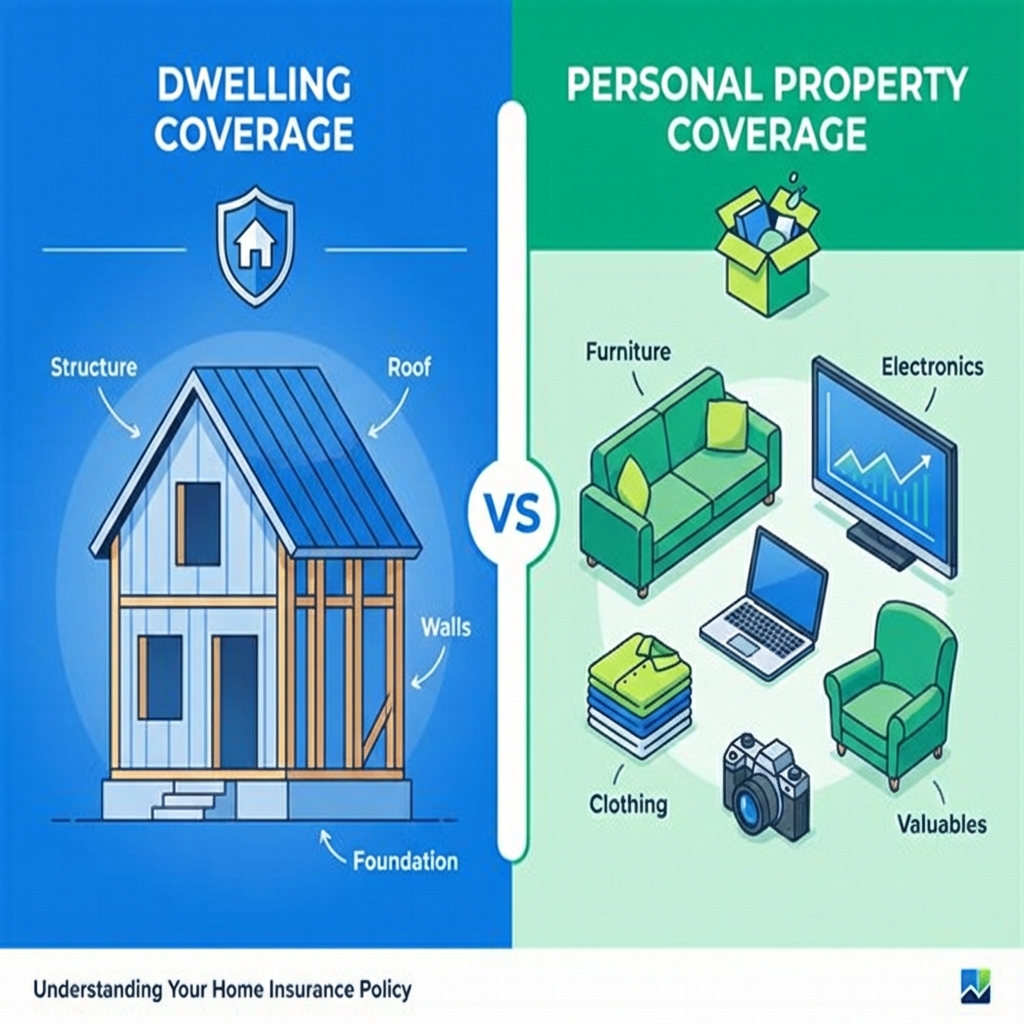
Dwelling vs. Personal Property Coverage: What's the Difference?
When you look at your home insurance policy, you will see two very large numbers at the top: Coverage A and Coverage C. One covers the house, and the other covers your stuff. But the line between them isn't always clear.
Understanding the distinction is critical because if you have a claim, you need to know which "bucket" of money applies. Here is the simplest way to tell them apart, known as the "Upside Down Test."
rotate_90_degrees_ccw The Upside Down Test
Imagine you could pick up your house, turn it upside down, and shake it.
- Everything that falls out is Personal Property (Coverage C).
- Everything that stays attached is Dwelling (Coverage A).
Coverage A: Dwelling
This pays to rebuild the physical structure of your home. It includes everything that is permanently attached to the house.
Coverage C: Personal Property
This pays to replace your belongings. These are the things you brought into the house when you moved in.
The "Special" Limits (Jewelry & Art)
While your policy covers personal property, it has strict "sub-limits" for certain high-value categories, especially for theft claims.
| Category | Typical Limit (Total) |
|---|---|
| Jewelry & Watches | $1,500 |
| Furs | $1,500 |
| Firearms | $2,500 |
| Silverware | $2,500 |
*Note: These limits usually apply only to theft. If they burn in a fire, the full limit often applies. Always check your specific policy language.
Conclusion
Knowing the difference ensures you aren't underinsured. If you just renovated your kitchen (Coverage A), tell your agent to increase your dwelling limit. If you just bought a $5,000 engagement ring (Coverage C), you need to "schedule" it separately, or you might only get $1,500 back if it's stolen.
Frequently Asked Questions
Does personal property coverage protect my stuff outside the home? expand_more
What if I run a business from home? expand_more
HomeInsuranceQuotes360 Team
Coverage Specialist